Where To See The Northern Lights In Reykjavik Without Paying Anything
You do not need a tour bus to see the aurora from Reykjavik. The city's own parks, hills and shorelines are the viewing platforms, and every one of them is free to stand on.
Short answer
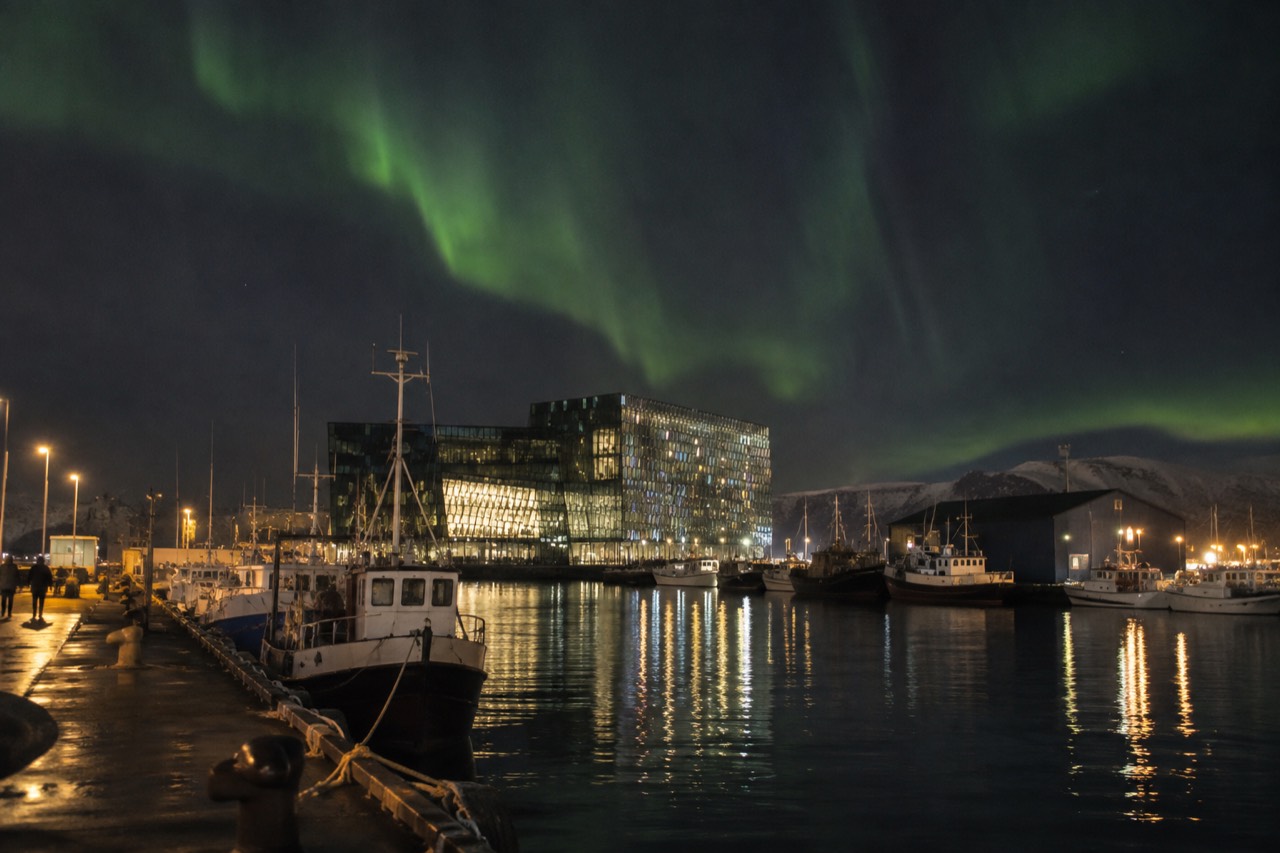
Yes, you can see the northern lights in Reykjavik itself, and it costs nothing. The season runs September to April. Free public viewing spots include Grótta, Öskjuhlíð, Elliðaárdalur, Klambratún and the Seltjarnarnes shore. You need a clear, dark sky and a spot away from the brightest streetlights, not a ticket.
The northern lights are the one Reykjavik attraction that cannot charge admission, because the show is in the sky and the sky does not take tickets. That does not stop people from assuming they need a paid minibus chase into the countryside. Often they do not. On a clear night between September and April, the aurora is regularly visible from public parks, hilltops and shorelines inside the city itself, and the difference between a good view and a mediocre one is usually where you are standing, not how much you paid to stand there.
This guide covers what the city's own tourism body recommends: which free spots actually work, when the season runs, what the tide and the tern nesting closure do to the Grótta plan, how to get home after the last bus, and how to fill the short daylight hours beforehand with walks that are also free. Every viewing location listed here is a public space with no fee, no ticket and no card requirement.
Can You Actually See The Northern Lights In Reykjavik?
Yes, and it happens often enough to plan around. Visit Reykjavik's own guidance names public spots inside or beside the city for aurora viewing, including Klambratún park, Öskjuhlíð hill, Grótta, Elliðaárdalur valley, the Seltjarnarnes shore, Lake Elliðavatn, Rauðhólar and Úlfarsfell. The city sits at a latitude where strong displays register on many clear winter nights, and the real obstacles are cloud and light pollution, both workable by choosing your spot.
The physics is on your side. Reykjavik sits well inside the auroral zone, so on nights with meaningful geomagnetic activity the lights appear directly overhead or to the north rather than hugging a distant horizon. The problem is never whether the aurora is above Iceland, it is whether there is a gap in the cloud and whether you can get far enough from sodium streetlights for your eyes to adjust.
Light pollution inside a small capital is more manageable than inside a large one. Reykjavik's centre is compact, and within a fifteen to twenty minute walk of the main square you can be in a dark park or on an unlit shoreline. Locals photograph the aurora from their neighbourhoods routinely, which is the most honest evidence that no tour is required. What a paid outing buys is a driver willing to chase clear skies across the region, which matters on a night when Reykjavik itself is socked in with cloud.
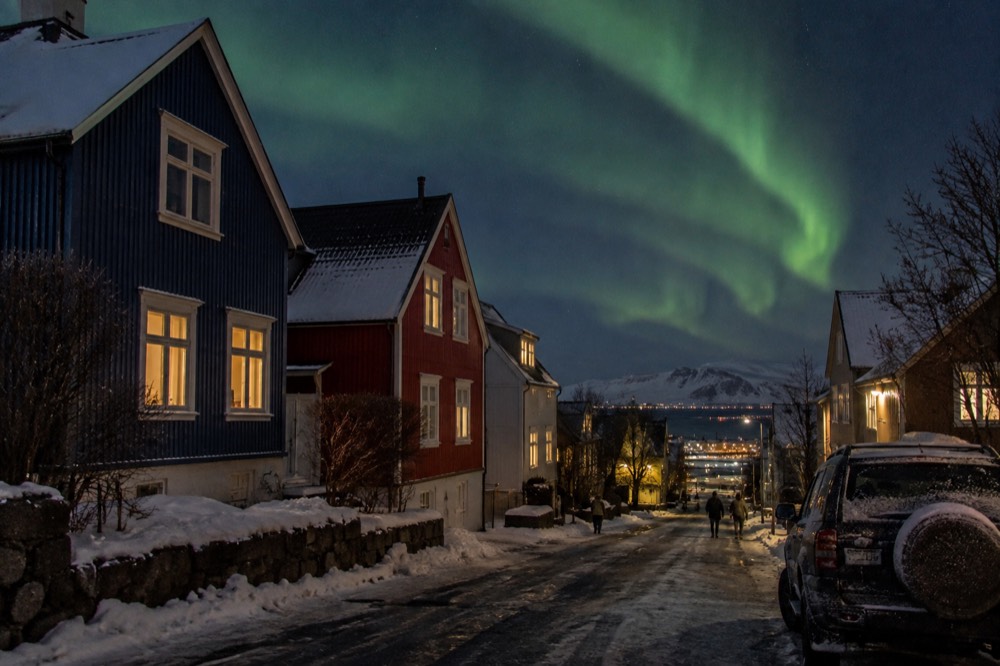
The practical approach is to treat aurora hunting as something you do on spec, repeatedly, rather than one planned event. Check the Icelandic Met Office forecast in the evening, look up, and if the sky is clear and active, walk to your nearest dark spot. Visitors who build their whole trip around one scheduled tour night frequently see nothing, while people who simply went outside on each clear night of a week-long stay often see the lights several times.
When Is The Northern Lights Season In Reykjavik?
The season runs from September to April, the months with enough darkness. Visit Reykjavik's aurora guidance states that window, and it is the figure to trust over the wider mid-August claim that appears elsewhere on the web. Inside the season, the lights are a darkness-and-weather phenomenon rather than a calendar one: any clear night can produce a display, and the equinox months combine long dark hours with statistically strong activity.
Darkness is the whole game. In late June the sun barely sets at all, with over 21 hours of daylight around the solstice, so no aurora is visible no matter what the sun is doing. By late August the nights are returning, and by mid-September you have genuinely dark hours after 22:00. The heart of the season is the deep winter, when darkness stretches from late afternoon to mid-morning and your chances on any single clear night are simply higher.
| Period | Dark hours for viewing | Notes for planning |
|---|---|---|
| May to mid-August | Effectively none | Midnight sun period, aurora not visible |
| September | From roughly 22:00 | Season opens, equinox activity often strong |
| October to November | From roughly 20:00 | Long dark hours, increasingly changeable weather |
| December to January | From roughly 18:00 | Darkest months, clouds are the main enemy |
| February to March | From roughly 20:00 | Equinox activity again, milder than midwinter |
| April | From roughly 22:00 | Season tails off as darkness shrinks |
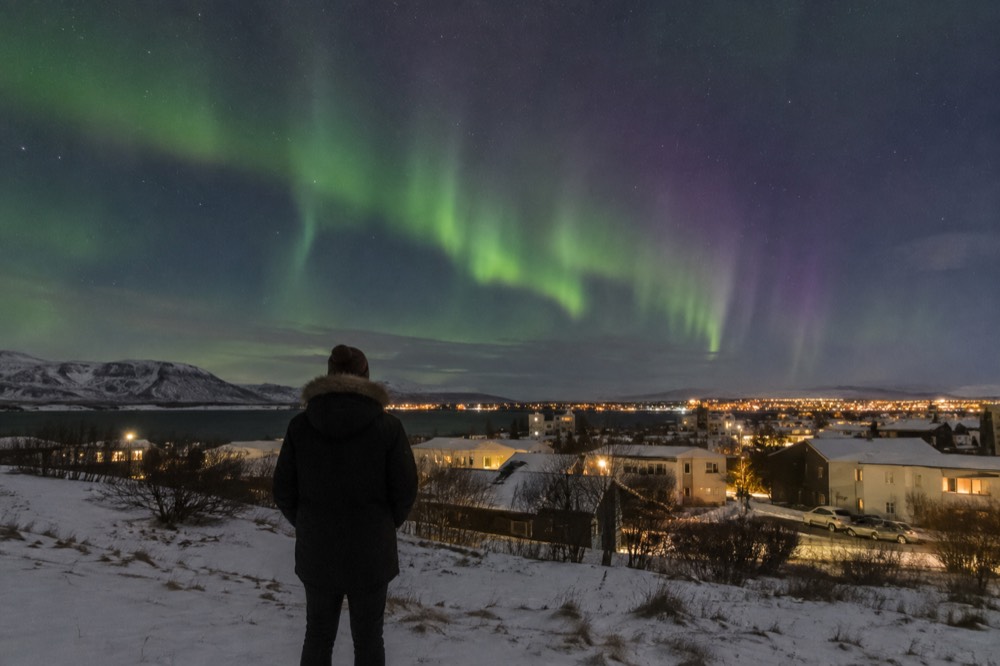
Weather, not the calendar, decides most nights. Iceland's winter sky is famously mobile, and a fully overcast 21:00 can clear into a perfect 23:00. Two habits make the difference: check the cloud forecast rather than just the aurora forecast, and be ready to go out late, since displays often strengthen after midnight.
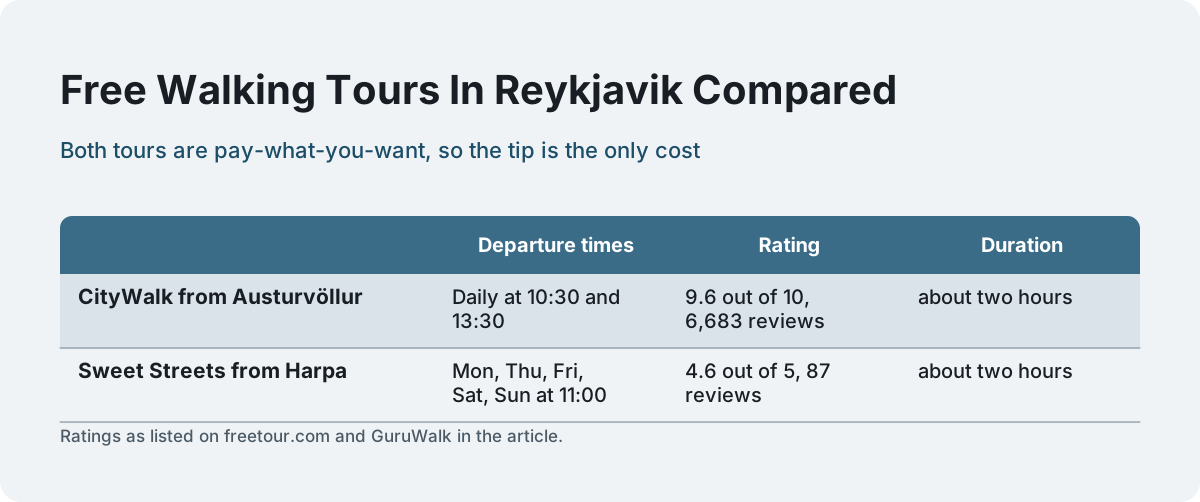
If you are visiting in the darker months, the daylight hours are short and the evening is long, which is exactly the shape of day that suits a free walking tour. The two long-running free walks in the city fill a morning or early afternoon nicely, and both are pay-what-you-want, so the decision costs nothing but time.
Where Are The Best Free Viewing Spots In Reykjavik?
The best free viewing spots in Reykjavik are the ones Visit Reykjavik itself recommends: Klambratún park, Öskjuhlíð hill, Grótta at Seltjarnarnes, Elliðaárdalur valley, Lake Elliðavatn, Rauðhólar, Úlfarsfell, and the darker shoreline stretches. All are public and free, and each suits a different situation, so pick two: one near your bed and one worth the trip.
Choosing a spot is about trading convenience against darkness. The nearer you are to the centre, the more light you fight. The spots a short bus ride out give you a genuinely dark northern horizon, which matters most when the aurora is faint and low rather than overhead.
| Spot | Distance feel from centre | Why it works | Watch out for |
|---|---|---|---|
| Klambratún park | Walkable | Open sky, easy access | Streetlight glow on three sides |
| Öskjuhlíð hill | Walkable, uphill | Trees and height block city light | Perlan building lights nearby |
| Grótta, Seltjarnarnes | Short bus ride | True dark horizon over the sea | Tide floods the causeway, closed 1 May to 15 July |
| Elliðaárdalur valley | Short bus ride | Sheltered, dark river valley | Some path sections unlit, bring a torch |
| Rauðhólar | Bus or car | Pseudocrater landscape, very dark | Furthest out, check the last bus home |
| Lake Elliðavatn | Bus or car | Dark water reflections | Residential lights on the south shore |
The pattern worth noticing is that several of the best spots are parks the city uses for everything else, which is why they have bus service, benches and paths rather than tour-bus parking. A night of aurora hunting in Reykjavik can be as simple as walking twenty minutes from a downtown guesthouse.
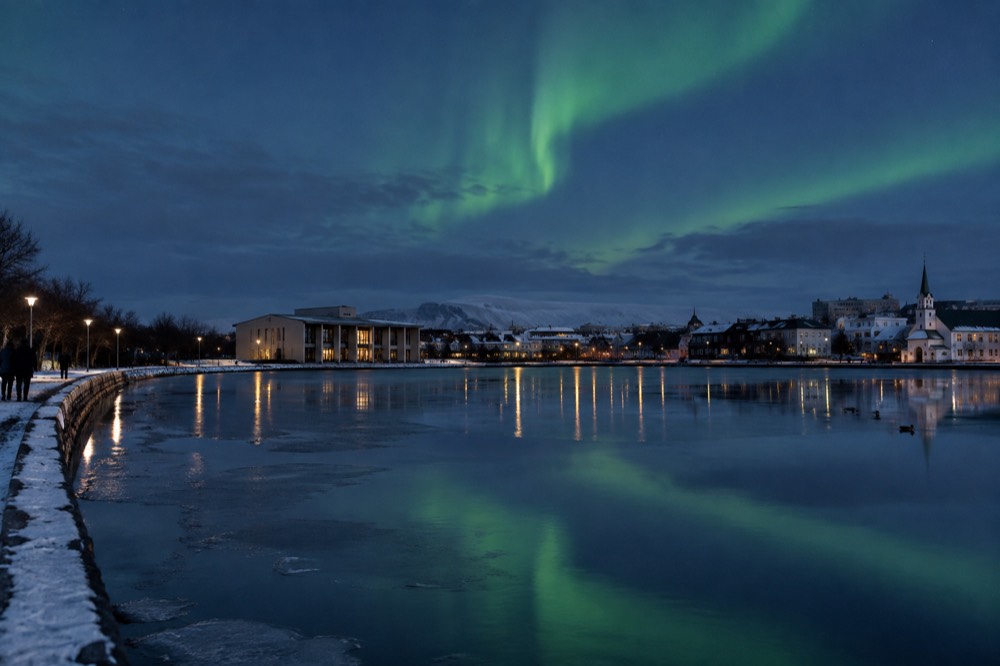
For the fullest list with each location's characteristics, Visit Reykjavik's northern lights guide is the primary source, and it is the page the table above is drawn from. The same body publishes a shorter top spots list for Reykjavik worth reading before you pick your night.
One honest caveat: on the strongest nights, the lights are visible from the middle of downtown, and plenty of visitors see their first aurora standing on Laugavegur looking up between buildings. The spots in the table are for the other nights, the more common ones, when a faint green band needs a dark horizon to be visible at all. Plan for the faint night and you get the strong night for free.
Before the sky darkens, there is daylight to use, and the city's dominant free walk is a good way to spend it. CityWalk's tour runs daily at 10:30 and 13:30 from Austurvöllur square in front of the Parliament building, lasts about two hours, and is listed on freetour.com, rated 9.6 out of 10 across 6,683 freetour.com reviews. It is tip-based, so there is nothing to pay until the end.
Is Elliðaárdalur Valley A Good Place To Watch The Aurora?
Yes, and it is one of the most underrated options. Elliðaárdalur is a green river valley cutting through Reykjavik's eastern suburbs, a city park with paved paths along the Elliðaá river, and its valley walls and tree cover cut a surprising amount of streetlight glare. Visit Reykjavik names it among the places to see the northern lights near the city. The trade-off is that some path sections are unlit, so bring a torch.
The valley's shape does the work. Walking down into it from the surrounding streets, the city drops away behind you and the open sky to the north appears over the river. On a clear night the difference between the pavement at the top of the path and the riverbank at the bottom is immediately obvious to your eyes.
It is also a spot with a second life in daylight, which makes it efficient for a short-winter-day itinerary. The same valley that gives you a dark aurora viewing spot at 21:00 is a pleasant walking route at 13:00, with salmon running up the river in late summer and horse riding trails through the woods. The city's own page for the valley describes it as one of the free things to do in Reykjavik, full stop, not only as a night spot.
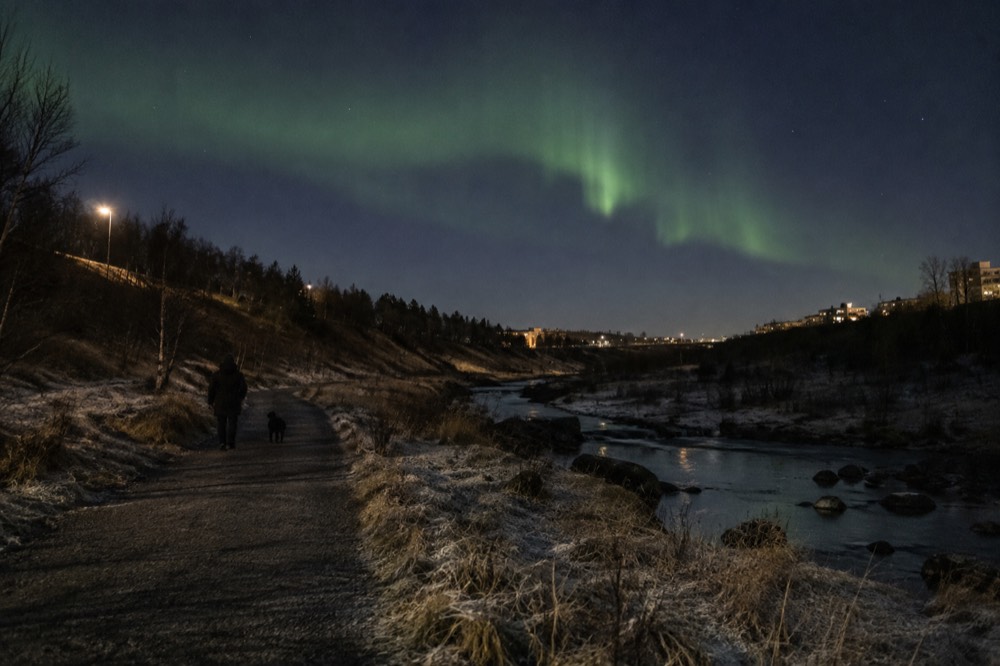
Practical notes: the valley stretches several kilometres, so choose your entry point with the last bus home in mind, and treat the unlit sections with respect in winter ice. If you want the fuller daytime picture, the Elliðaárdalur valley guide covers the paths, the river and how to get there by bus.
Can You See The Aurora From Grótta Lighthouse?
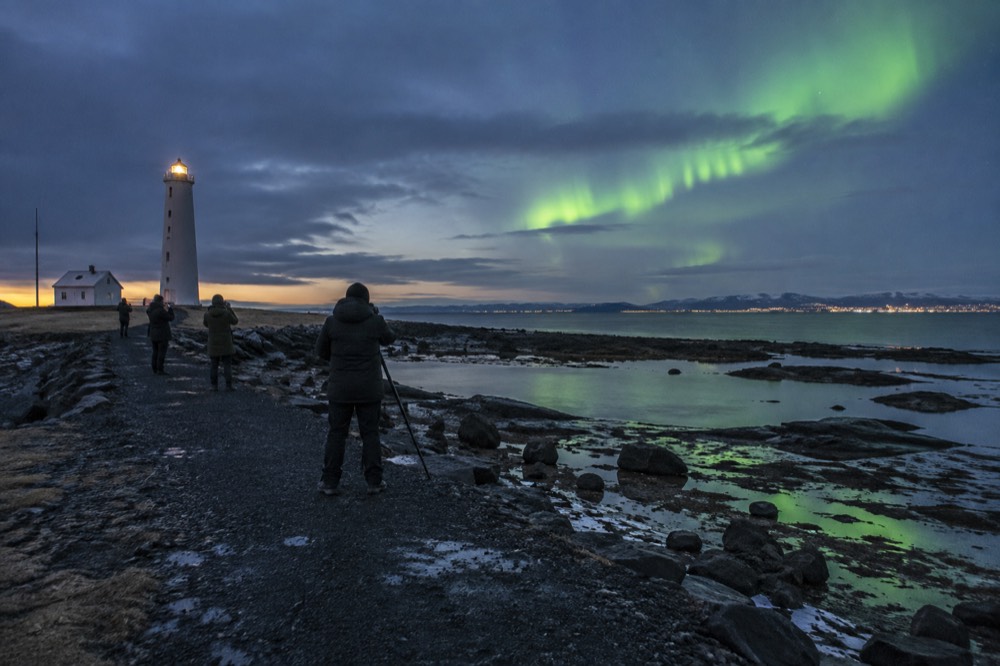
Yes, and Grótta is arguably the best dark-sky spot within reach of the city, with two conditions that must be respected. The causeway to the lighthouse is only walkable around low tide, and the whole area is closed to visitors from 1 May to 15 July for arctic tern nesting. Outside those limits it is free, it is dark, and its north-facing horizon over the open sea makes it the spot locals choose for photography.
Grótta sits at the tip of the Seltjarnarnes peninsula, west of Reykjavik proper, a nature reserve with a small lighthouse on an islet joined to the mainland by a stone causeway. The reserve status is not decorative: it keeps the surrounding area free of development and its sky free of the light that ruins faint displays. In July 2026 the reserve was formally expanded, which reinforces the protections that make the peninsula dark in the first place.
The tide rule is the one that catches people. At high tide the causeway is under water, and the sea does not negotiate. Check a tide table for the evening before you commit, and build in margin on both sides, because standing on an islet watching the water rise over your way home is a bad way to end an aurora night. The nesting closure from 1 May to 15 July mostly falls outside the aurora season anyway, but late-season April visitors and early September visitors are unaffected, since the closure ends mid-July.
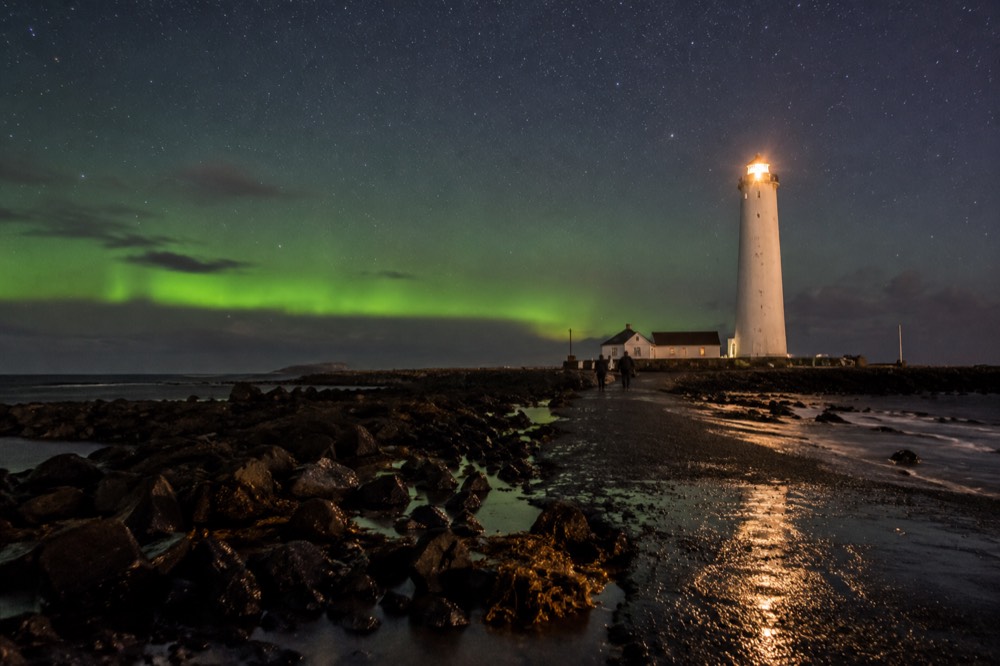
Getting there is a short bus ride from the centre, and the walk out along the peninsula shore is part of the appeal. The Seltjarnarnes municipality page on Grótta is the authority on the closure and the reserve. For the fuller picture on the lighthouse, the causeway and the tide timing, see the Grótta lighthouse guide.
Is Öskjuhlíð The Easiest Aurora Viewpoint To Reach?
It is the best walk-from-the-centre option when you do not want to depend on a bus. Öskjuhlíð is a wooded hill beside Perlan, ten to fifteen minutes on foot from the pond, and its trees and elevation block much of the city's light. The free part is the hill itself: the woods and trails are public. The Perlan building on top is a separate, ticketed attraction.
This distinction matters, because Öskjuhlíð is often mentioned in the same breath as Perlan, and Perlan is not free. Its observation deck is included only with a paid ticket and cannot be bought separately. The hill's trails and viewpoints, by contrast, are ordinary public woodland, open at all hours, and the elevation gives you a north-facing vista over the water that the flat centre cannot match.
The woods do real work here. Walking up through the trees, the birch and pine screen the residential streets below, and by the time you reach the upper clearings the sky overhead is noticeably darker. It is the spot to choose on a night when the aurora forecast is strong and you want to be outside within ten minutes of seeing the alert, without waiting for a bus or planning a route.
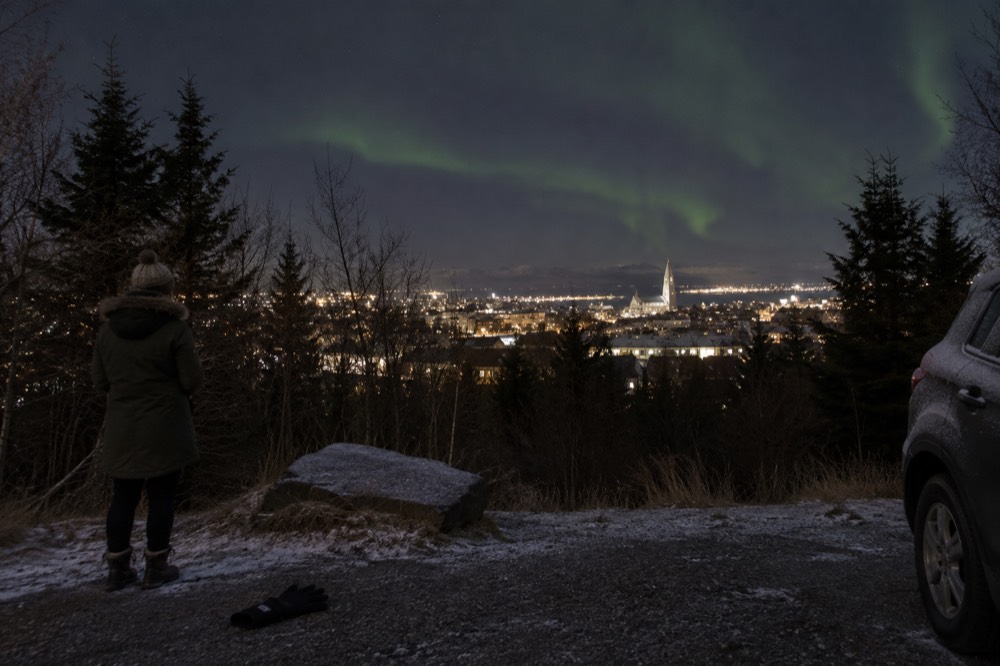
The hill also earns its place in a daytime itinerary: the trails connect through to the coast at Nauthólsvík and make a pleasant loop walk. Note that the geothermal beach below is a paid attraction year-round, despite the persistent internet claim of a free summer window, so swim elsewhere or budget for it. The Öskjuhlíð guide covers the trails and what is and is not free on and around the hill.
Which Free Walking Tours Fill The Daylight Hours?
Two free walking tours suit English-speaking visitors in Reykjavik: the CityWalk tour departing from Austurvöllur, rated 9.6 out of 10 across 6,683 freetour.com reviews, and the Sweet Streets walk from Harpa, rated 4.6 out of 5 across 87 GuruWalk reviews. A third option, by Rainbow Tours, runs in Spanish only, and since all are pay-what-you-want, your daylight hours before aurora hunting cost nothing fixed. A free walk covers this ground: Spanish-Language Legends Walk.
The field is small, and it is better to say so plainly than to imply a wide menu. CityWalk is the long-running, dominant free walk in the city, running daily at 10:30 and 13:30, about two hours from Austurvöllur in front of the Parliament building, with a maximum of six people per booking on the operator's own form. It covers the Parliament, Laugavegur, Tjörnin, the old turf cottages of Grjótaþorp and Rainbow Street, finishing at City Hall, which handily drops you at the pond with an afternoon to spare.
Sweet Streets is the smaller GuruWalk option, meeting inside Harpa by the Rammagerðin store. It runs Monday, Thursday, Friday, Saturday and Sunday at 11:00 in English, about two hours, and it is cash only: on a pay-what-you-want walk the tip is the entire payment, so a visitor with no banknotes cannot pay the guide at all. Bring cash. Its meeting point has one wrinkle, in that the structured address and the guide's own written instruction sit a few hundred metres apart, so follow the guide's instructions on the GuruWalk listing rather than any map pin.
The Rainbow Tours walk is the Spanish-language option, meeting at the Ingólfur Arnarson statue on Arnarhóll, running Monday to Friday at 17:00 and Saturday and Sunday at 11:00. Its GuruWalk listing was created on 27 August 2026 and is labelled new by the platform, with no reviews yet. The same walk also appears on freetour.com, and it is genuinely the same walk on both platforms, not a second option. For Spanish speakers it is a real choice; for everyone else the two walks above are the field.
One thing all three share: cancellation is free on the GuruWalk walks, and the guides ask that you cancel rather than no-show, since a minimum of five bookings is needed for a walk to run. In the deep winter months that minimum matters, so if you book and your plans change, release the slot. For more on filling the darker months generally, the free things to do in Reykjavik in winter guide collects the indoor and outdoor options in one place.
What Time Should You Head Out, And How Do You Get Home?
Head out when the sky is clear and dark, which in deep winter means anytime from about 18:00, and in September and April closer to 22:00 or later. Displays often strengthen after 21:00 and can peak well after midnight, so the real planning question is the journey home: Strætó's regular buses thin out in the evening, the night bus fare is 690 ISK, and a viewing spot you cannot leave is a trap.
Time your night around transport, not around the forecast alone. The single adult fare on Strætó's capital-area buses is 690 ISK, paid by contactless card or app and valid for 75 minutes including transfers, and children 11 and under ride free. Day passes have been discontinued, so there is no pass to buy that fixes your evening; you simply pay per ride. If your chosen spot is Klambratún or Öskjuhlíð, you can walk home. If it is Grótta, Rauðhólar or Elliðavatn, check the last scheduled departure before you commit to the far end of the trail.
| Getting there | Cost | Notes for an aurora night |
|---|---|---|
| Walking (Klambratún, Öskjuhlíð) | Free | 10 to 20 minutes from the centre, no schedule to miss |
| Strætó bus | 690 ISK single adult | Contactless or app, valid 75 minutes with transfers |
| Children 11 and under | Free | On all Strætó capital-area buses |
| Night bus | 690 ISK | Runs on limited routes, check the night network map |
| Taxi back | Metered, not published here | The fallback if you miss the last bus |
What you wear matters more than what you carry. You will be standing still in the dark for an hour or more, which is a different cold from walking, so wear more than the walk over suggests: proper boots on ice, layers, hat and gloves, and a thermos. A torch with a red light mode preserves your night vision and everyone else's. A tripod separates a photograph from a smudge.
| Item | Why it matters on an aurora night |
|---|---|
| Insulated boots | Standing still on ice for an hour is colder than walking |
| Hat and gloves | You will be handling a phone or camera in the cold |
| Layers, more than feels right | Aurora watching is stationary, dress for it |
| Torch, red-light mode if possible | White light ruins night vision, yours and others' |
| Thermos with a hot drink | The difference between one hour out and giving up at 20 minutes |
| Phone aurora app and cloud forecast | The Icelandic Met Office forecast is the standard reference |
Do You Need A Paid Northern Lights Tour From Reykjavik?
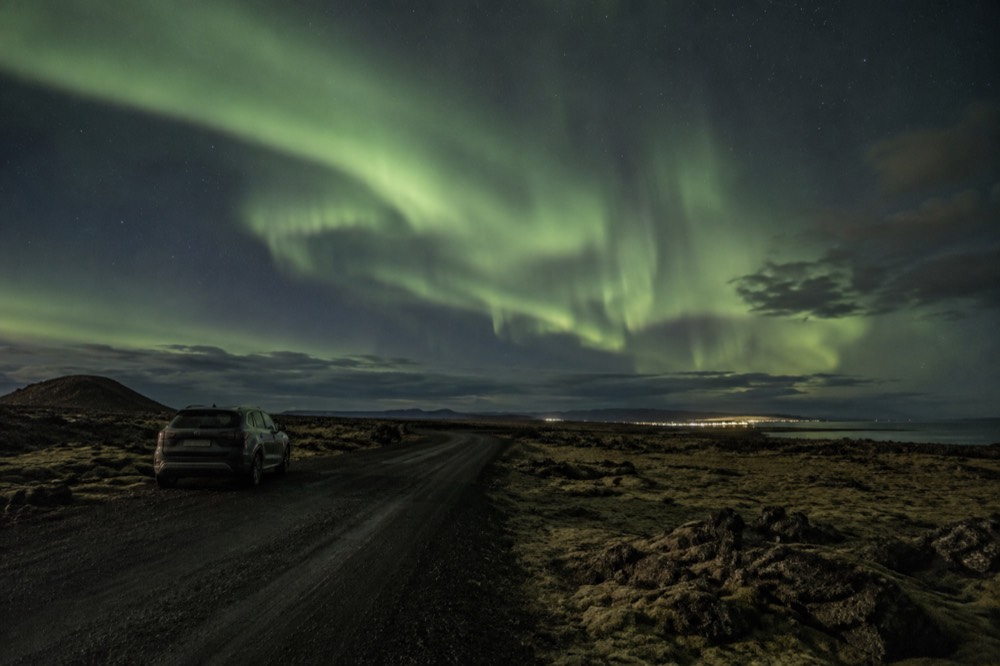
No, not to see the lights, and plenty of visitors see them from the free public spots in this guide. A paid tour buys two things: a driver who chases clear skies across the region on a night when Reykjavik itself is cloudy, and someone else's camera expertise and patience. If you are in the city for several nights and willing to go out on each clear one, hunting free gives you better odds than a single paid excursion.
That is the honest arithmetic. One tour night is one roll of the weather dice. Four or five evenings of walking out whenever the sky clears is four or five rolls, at a cost of nothing but lost sleep. The people who leave Reykjavik disappointed are usually the ones who scheduled one aurora night and slept through the rest.
The regional chase does have genuine value for short-stay visitors. If you have exactly one night and the capital is under cloud, a tour with the freedom to drive two hours to a gap in the cloud is the only realistic option, and that is a decision worth money. But it is a weather-insurance decision, not an access decision: the lights themselves are free, and the city's own viewing spots are free, as this site's Free Things To Do In Reykjavik coverage keeps track of in detail.
If you do book a paid tour, apply the same scrutiny you would to anything in Iceland: check the cancellation policy before paying, since cloud-chasing tours cancel often and the reputable ones refund fully. And if the tour is a bus to a dark field, remember that several of the free spots above offer comparable darkness without the schedule.
Common Questions About Seeing The Northern Lights In Reykjavik
Can you see the northern lights in Reykjavik itself?
Yes. The aurora is regularly visible from public spots inside the city on clear, dark nights between September and April, including Klambratún, Öskjuhlíð, Elliðaárdalur and Grótta. You need a dark spot away from the brightest streetlights, not a tour bus.
What is the best month to see the northern lights in Reykjavik?
Any month from September to April can work, since the lights depend on darkness and clear sky rather than the calendar. February and March combine long dark hours with strong equinox activity and slightly milder weather than midwinter.
What time of night do the northern lights appear in Reykjavik?
There is no fixed time, but displays often strengthen after 21:00 and can continue well past midnight. In deep winter the sky is dark from about 18:00, so any clear evening hour is worth checking the sky.
Is Grótta open for aurora viewing?
Grótta is free and open outside the 1 May to 15 July nesting closure, but the causeway to the lighthouse floods at high tide, so check a tide table before you go. Outside those limits it is one of the darkest horizons within reach of the city.
How much does it cost to see the northern lights in Reykjavik?
Nothing. Every viewing spot in this guide is public and free, and the city bus fare to reach the farther ones is 690 ISK for a single adult ride, with children 11 and under free.
Do free walking tours in Reykjavik run in winter?
Yes. The CityWalk free tour runs daily at 10:30 and 13:30 year-round, and the Sweet Streets walk runs Monday, Thursday, Friday, Saturday and Sunday at 11:00 in English. Both are pay-what-you-want, and both need a minimum of five bookings to run, so cancel rather than no-show if your plans change.